
Tristate Prep Hoops Legacy and Metropolitan College Recruiting
The basketball corridor spanning New York City, Philadelphia, and New Jersey represents one of the most fertile talent pipelines in North American sports finance and talent scouting. For nearly a century, urban asphalt courts, parochial powerhouse programs, and public school athletic leagues across these three markets have developed iconic hall-of-fame talent.
Front-office scouts, college recruiters, and grassroots shoe circuit executives view this regional ecosystem as a primary barometer for elite guard play and toughness. Understanding how this talent pool historically concentrated in local universities provides essential context for modern college basketball roster architecture.
Tristate Prep Foundations and Urban Basketball Heritage
New York City high school basketball established the baseline for urban point guard development, producing legends like Kareem Abdul-Jabbar from Power Memorial and Stephon Marbury from Lincoln. Simultaneously, Philadelphia high school basketball developed dominant physical forces, anchored by Wilt Chamberlain out of Overbrook, Kobe Bryant from Lower Merion, and Rasheed Wallace from Simon Gratz. New Jersey added historic Catholic school powerhouses like St. Anthony and St. Patrick, producing elite talent including Kyrie Irving and Karl-Anthony Towns. Together, these three neighboring territories created an interconnected talent web that dominated national recruiting rankings.
The competitive density of Catholic Youth Organization leagues, Public Schools Athletic Leagues, and summer streetball tournaments accelerated player development. High school prospects honed their decision-making under intense physical pressure and national media scrutiny long before entering collegiate environments. Athletic directors and college scouts evaluated this regional talent pool based on structural durability and mental processing speed. This environment created a continuous pipeline of blue-chip prospects that fueled national championship contenders across the country.
NYC Playground Royalty and St. John’s Retention
When elite New York City prospects opted to remain local for college, St. John’s University routinely transformed into a national powerhouse. Brooklyn native Chris Mullin starred at Power Memorial before leading St. John’s to the 1985 Final Four as a consensus national player of the year. Mark Jackson out of Bishop Loughlin joined Mullin in Queens, establishing a homegrown backcourt that elevated the university into a premier national brand. Local stars like Walter Berry from Benjamin Franklin and Ron Artest from LaSalle Academy similarly chose Carnesecca Arena over out-of-state offers.
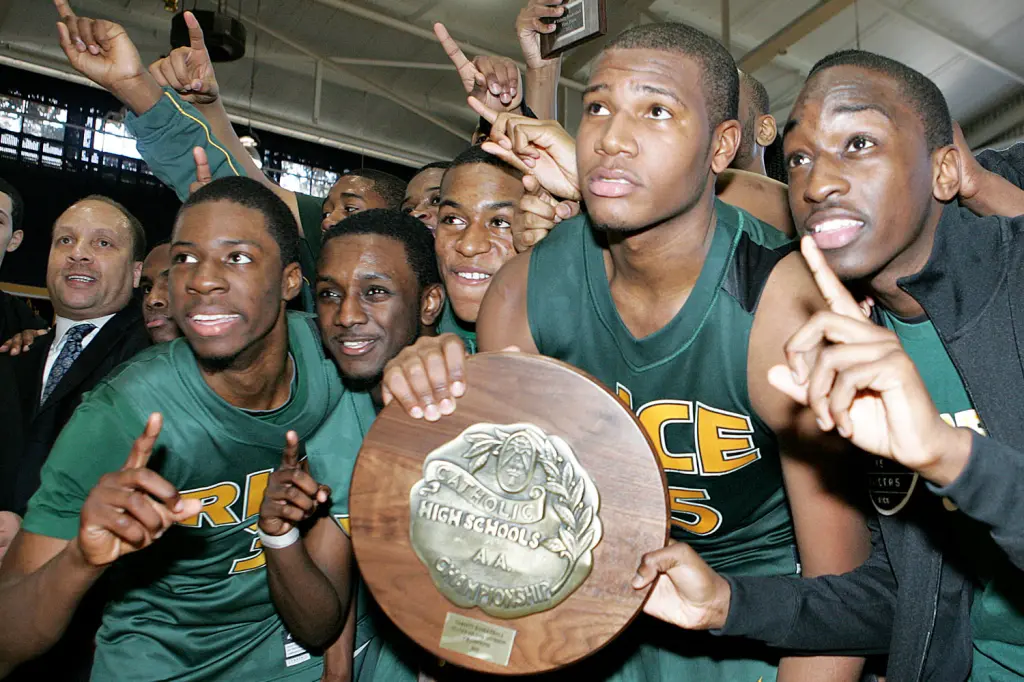
The pinnacle of high school hype staying local occurred when Rice High School phenom Felipe Lopez committed to St. John’s in 1994, capturing national magazine covers and boosting program revenues. Retention of five-star NYC prospects provided local universities with immediate television draw, merchandise licensing growth, and high-margin ticket yields at Madison Square Garden. When local legends chose St. John’s, the university functioned as the commercial center of Big East basketball. Front offices in the NBA benefited from evaluating local talent in high-pressure metropolitan media environments.
New Jersey and Philadelphia Talent Pipelines
New Jersey high school legends similarly energized metropolitan programs, most notably at Seton Hall University in South Orange. St. Anthony shooting star Terry Dehere and St. Patrick point guard Shaheen Holloway chose Seton Hall over national powerhouses, driving the Pirates to Big East titles and elite tournament runs. Rice guard Andre Barrett also crossed the Hudson River to lead Seton Hall, proving that North Jersey programs could consistently land top talent. These commitments demonstrated how regional brand affinity could counter out-of-market recruiting budgets.
In Philadelphia, local legends frequently stayed nearby to fuel Big 5 rivalries at Villanova, Temple, Saint Joseph’s, La Salle, and Penn. However, the proximity of New York City programs allowed Big East schools to aggressively target Philadelphia prep stars. The cross-pollination of players moving between New York, New Jersey, and Philadelphia created intense geographic rivalries that drove regional television ratings. Program builders recognized that securing local commitment walls was the most cost-effective path toward sustainable postseason success.
Modern NIL Economics and Metropolitan Recruiting Rebirth
In the modern era of Name, Image, and Likeness licensing, metropolitan universities are leveraging local commercial capital to retain regional elite prospects. High school stars from New York City, Philadelphia, and New Jersey now evaluate college programs through local media market reach and brand endorsement potential. St. John’s, Seton Hall, and Rutgers are utilizing collective investment frameworks to compete directly with national blue-blood institutions for Tristate talent. Securing local high school talent once again provides immediate commercial equity for metropolitan athletic departments.
The strategic alignment of local corporate sponsorship, major broadcast exposure, and grassroots talent identification is driving a renaissance across metropolitan college basketball. Program executives realize that keeping top prospects in the NYC market generates unique commercial yields that traditional college towns cannot match. As roster construction models adapt to transfer portal dynamics, the historic Tristate pipeline remains the baseline for building elite college basketball programs. Retaining local stars continues to be the most efficient investment strategy in modern athletic enterprise.
SOURCES
- New York City’s All-Time Greatest High School Basketball Players, Yardbarker, https://www.yardbarker.com/nba/articles/new_york_citys_all_time_greatest_high_school_basketball_players/s1__38609816
- Great Players in St. John’s Basketball History, CBS New York, https://www.cbsnews.com/newyork/news/12-great-players-in-st-johns-basketball-history/
- Seton Hall Men’s Basketball Alumni and NBA History, Seton Hall Pirates Athletics, https://shupirates.com/news/2006/10/27/Seton_Hall_NBA_Players
- Greatest High School Basketball Teams and Legends of All Time, Stadium Talk, https://www.stadiumtalk.com/s/greatest-high-school-basketball-teams-de1f0baf83734149
PHOTO SOURCES