
USA Rallies From Fourteen Down To Secure Fifth Straight FIBA World Cup Gold
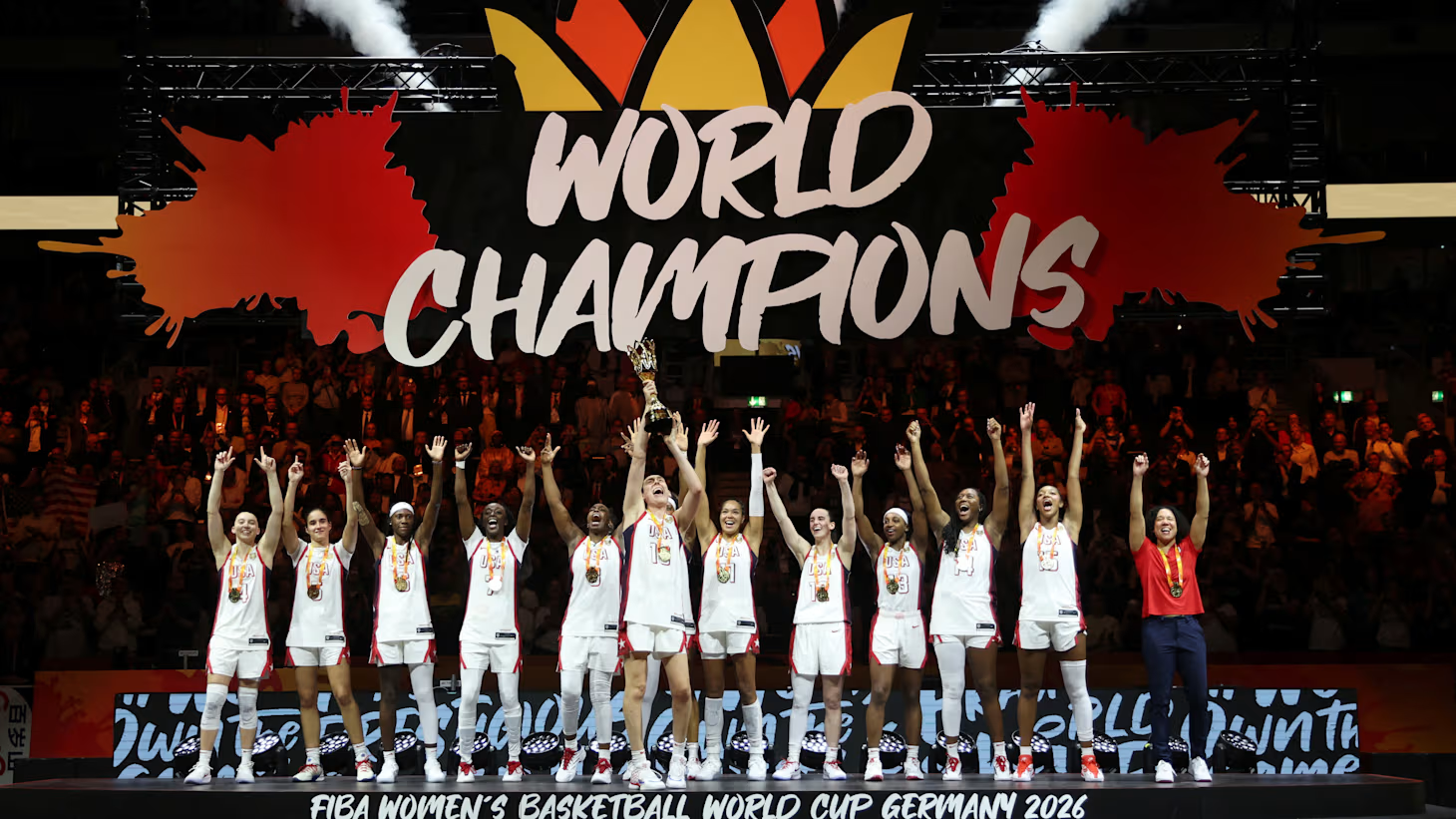
The United States Women’s National Basketball Team captured its fifth consecutive FIBA Women’s Basketball World Cup gold medal on September 13, 2026, defeating France 97-79 at Uber Arena in Berlin. Facing a fourteen-point deficit early in the second quarter, the Americans executed a dramatic second-half turnaround to extend their tournament winning streak to thirty-six games. Tournament Most Valuable Player Breanna Stewart led the American attack with twenty-two points and ten rebounds, while guard Jackie Young contributed eighteen points on four three-pointers. The 18-point comeback victory reinforces USA Basketball’s institutional dominance and expands the commercial valuation of global women’s basketball properties.
Second Quarter Adversity and Tactical Spacing Adjustments
France established early tactical leverage by exploiting perimeter shooting volume and fast-break transition opportunities. Led by center Dominique Malonga’s twenty-one points and forward Gabby Williams’ twenty points, the French national team orchestrated an 11-0 run to build a 31-17 lead midway through the second quarter. France’s physical perimeter defense forced early American turnovers, disrupting secondary ball movement and isolating high-post playmakers. The early fourteen-point deficit represented the largest international challenge faced by USA Basketball since the 2024 Paris Olympic gold-medal game.
USA Basketball head coach Kara Lawson adjusted offensive spacing during the final four minutes of the half, placing guard Caitlin Clark on the floor to stretch France’s zone coverage. Young hit two timely three-pointers while Clark delivered twelve points, including a buzzer-beating three-pointer to trim France’s lead to 45-43 at halftime. Rearranging perimeter rotations allowed the Americans to penalize aggressive help defense without sacrificing defensive rebound positioning. Closing the first half with high-margin scoring possessions re-established internal momentum heading into the locker room.
Third Quarter Dominance and Defensive Rebound Leverage
The Americans completely dictated terms during a decisive third quarter, outscoring France 30-12 to transform a two-point deficit into a sixteen-point lead. Stewart initiated an 11-2 scoring run coming out of half, scoring four points while drawing double teams that opened perimeter driving lanes for Kahleah Copper. Combined with veteran floor general Chelsea Gray’s twelve points and five assists, Team USA systematically broke down France’s half-court containment schemes. The American bench outscored France’s reserves while securing a 36-27 total rebounding advantage across forty minutes.
Defensively, Team USA holding Williams to just four second-half points neutralized France’s primary half-court option. Heavy pressure on ball-handlers forced consecutive turnovers, accelerating high-percentage transition opportunities for Stewart and Copper. Building a 73-57 lead by the end of the third period eliminated France’s operational margin for error. The third-quarter surge displayed how deep athletic rotation depth translates directly into high-leverage defensive suppression.
Institutional Roster Building and Generational Asset Integration
Integrating elite emerging talent alongside proven championship veterans remains the cornerstone of USA Basketball’s front-office roster architecture. Navigating the transition from legacy anchors to young superstars like Clark, Angel Reese, and Paige Bueckers protects the program’s long-term competitive pipeline. Combining Stewart’s four World Cup gold medals with first-time international winners optimizes roster balance without compromising championship expectations. Executive management relies on this continuous talent integration model to preserve unmatched international supremacy.
For international governing bodies, France’s historical run to its first World Cup silver medal confirms narrowing global competitive gaps. European programs utilizing high-volume perimeter systems pose legitimate tactical threats to traditional interior power dynamics. However, USA Basketball’s unmatched depth across all twelve roster spots ensures the program maintains primary structural advantages. Retaining operational control over international play provides invaluable leverage when negotiating global media rights and sponsorship valuations.
Global Commercial Valuation and Broadcast Asset Growth
The record-extending twelfth World Cup title enhances commercial asset values across corporate sponsorship networks and broadcast media partners. Televised live from Berlin across global broadcast windows, the high-stakes final generated massive digital viewership spikes across international sports networks. Individual brand profiles for stars like Stewart and Clark experienced immediate commercial growth across corporate marketing portfolios. High-visibility international tournaments serve as crucial expansion engines for women’s basketball enterprise value.
As USA Basketball prepares for the 2028 Los Angeles Olympic cycle, the organization retains undisputed leadership across global sports governance. Managing workload distribution and talent development across WNBA seasons and international tournaments will dictate future operational success. Front offices and sports executives view Berlin’s 97-79 comeback victory as a masterclass in championship resilience and talent consolidation.
SOURCES
- USA beats France, wins fifth consecutive women’s FIBA World Cup title, Sportsnet
- USA defeat France to win 12th FIBA Women’s Basketball World Cup, Al Jazeera
- US wins fifth straight women’s FIBA World Cup title, beating France, AP News
- Fiba Women’s Basketball World Cup final: USA 97-79 France, The Guardian
PHOTO SOURCE:
OLYMPICS