OG Anunoby Contract Proves Cap Efficient In Second Apron Era
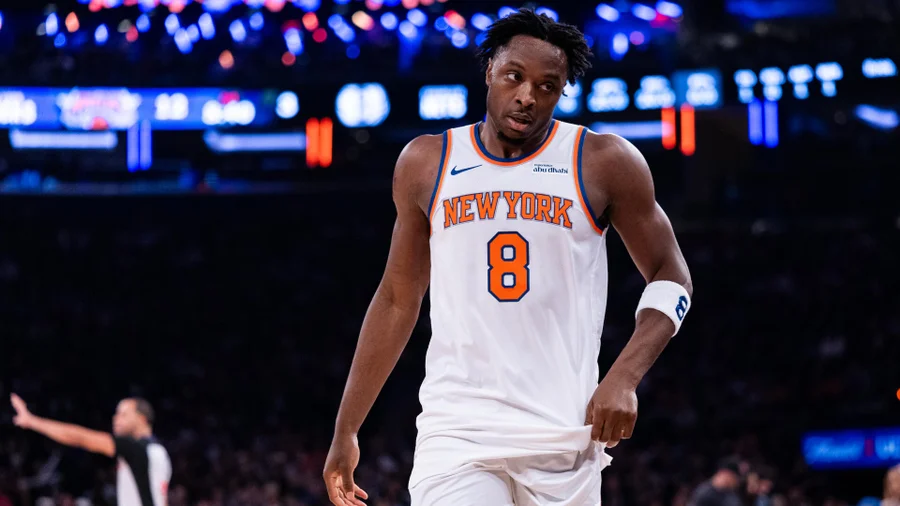
When President of Basketball Operations Leon Rose signed wing defender OG Anunoby to a five-year, 212.5 million dollar contract extension in the summer of 2024, rival front offices questioned the total valuation for a non-All-Star. Two seasons later, that deal stands as the financial centerpiece of a championship roster following New York’s 16-3 postseason run. By pairing Anunoby’s versatile perimeter defense with Jalen Brunson’s discounted contract, the Knicks established an efficient salary structure. Evaluating Anunoby’s deal against max-tier star contracts demonstrates how high-end complementary players deliver superior surplus value under strict second-apron constraints.
Second Apron Realities and Comparative Max Contract Valuation
Under the modern collective bargaining agreement, franchises spending above the second apron face severe roster-building penalties, including frozen draft picks and trade restrictions. Comparing Anunoby’s contract to premier scoring guards illustrates how front offices evaluate salary cap allocation. Phoenix Suns guard Devin Booker commands an annual salary approaching 68 million dollars in the final year of his extension, whereas Anunoby’s deal tops out near 48 million dollars on a player option. This 20 million dollar annual variance grants New York critical payroll flexibility to maintain competitive depth across the rest of the roster.
Front-office analysts are increasingly questioning whether paying maximum money to offensive lead options who fall short of true top-five status is viable under current cap rules. Anunoby provides elite multi-positional defense and complementary offensive finishing while consuming fifteen million dollars less per season than traditional primary scorers. The Boston Celtics trading wing Jaylen Brown due to escalating apron costs reflects growing executive anxiety over paying secondary stars top-tier max money. New York avoided this structural trap by securing Anunoby at a functional sub-max tier.
Synergy With Discounted Superstar Contracts
The financial viability of Anunoby’s 212.5 million dollar agreement relied heavily on Jalen Brunson accepting a discounted four-year extension. Brunson leaving significant cap space on the table enabled Leon Rose to overpay slightly for elite defensive depth without triggering second-apron penalties. This coordinated financial strategy allowed New York to absorb Karl-Anthony Towns’ large contract while retaining core rotational talent like Josh Hart and Mikal Bridges. The resulting roster balance allowed head coach Tom Thibodeau to deploy elite two-way lineups throughout their championship run.
By locking in core rotation players under predictable contract trajectories, New York protected itself against sudden cap spikes and roster attrition. Anunoby’s impact on defensive rating metrics validated the team’s initial trade outlay of Immanuel Quickley and RJ Barrett. Front offices observing New York’s success now recognize that overpaying for ideal role alignment is far more effective than paying full max dollars for redundant scoring options. Strategic alignment between star compensation and role-player pricing remains the baseline for sustainable roster building.
Roster Architecture and Future Cap Optimization
As the salary cap increases, Anunoby’s 42 million dollar average annual value represents a shrinking percentage of total cap space. While traditional evaluation metrics prioritize individual accolades like All-NBA or All-Star selections, modern analytics departments prioritize impact on net rating and postseason winning percentage. Anunoby’s presence provided defensive stability that allowed Brunson and Towns to operate with total offensive freedom. This complementary dynamic proved far more valuable during the playoffs than stacked multi-star lineups in Phoenix or Milwaukee.
The success of Leon Rose’s roster design offers a clear template for contender front offices operating under tight luxury tax penalties. Cap managers must identify elite complementary talents who elevate primary options without consuming forty percent of the team’s payroll. New York demonstrated that holding high-level defensive wings on long-term deals creates a durable competitive advantage. The $212.5 million investment once labeled an overpay now represents a masterclass in modern salary cap mechanics.
The evolution of New York’s balance sheet demonstrates that championship roster construction requires disciplined financial alignment rather than raw star accumulation. OG Anunoby provided the elite perimeter defense necessary to secure a championship, while his contract structure preserved organizational flexibility under the second apron. Front offices across the National Basketball Association will continue studying Leon Rose’s blueprint as they navigate the strict financial constraints of modern sports finance.
SOURCES
- New York Knicks Team Salary and Contract Breakdown, Spotrac
- OG Anunoby’s $212 Million Knicks Contract Is Showing Unexpected Silver Linings, Daily Knicks
- Second Apron CBA Mechanics and NBA Roster Construction Rules, ESPN
- New York Knicks Front Office Roster News and Analysis, Daily Knicks
SOURCES
- Photo by Getty Images