
Caitlin Clark Drives Historic Capital Realignment Across WNBA Franchises
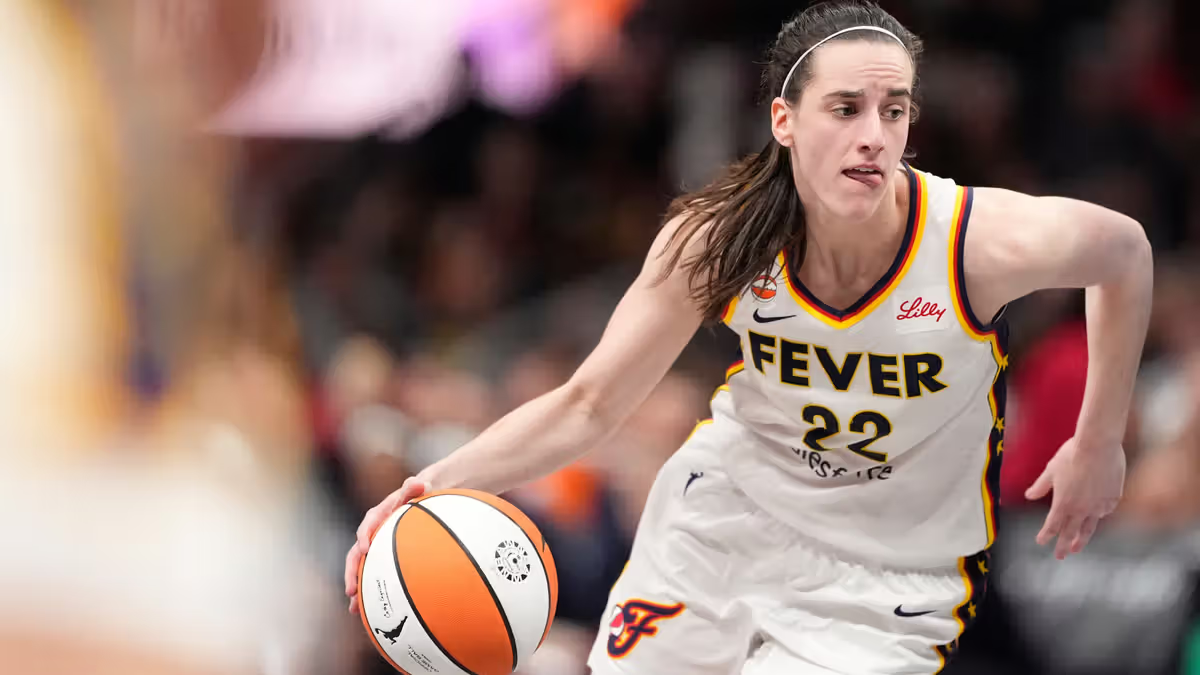
The Women’s National Basketball Association has entered an unprecedented financial era, anchored by a multi-partner eleven-year media rights deal valued at 3.1 billion dollars. Averaging 281 million dollars annually, this contract represents nearly a seven-fold increase over previous distribution agreements and underscores a complete economic shift. Academic economic studies and ticketing data confirm that approximately one out of every six tickets sold across the league is directly linked to the interest surrounding Indiana Fever guard Caitlin Clark. This unprecedented surge in consumer demand has forced league executives, network programmers, and institutional investors to recalibrate their financial projections and revenue distribution frameworks.
Media Rights Restructuring Signals New Commercial Valuation
The scale of the league’s media deal with broadcast partners including Disney, NBCUniversal, Amazon Prime Video, Scripps, USA Network, and Paramount reflects a permanent departure from legacy sports broadcasting models. Under the new contract structure, broadcast partners have committed to absorbing major production and marketing costs. This structural shift allows rights fees to flow straight to franchise balance sheets as clean, high-margin operating revenue. National telecasts will cover more than sixty-five percent of the regular season, providing unprecedented distribution depth across network television, cable, and direct-to-consumer streaming platforms.
Network executives are competing aggressively for live sports rights that reliably deliver high audience engagement across younger demographic segments. The inclusion of an explicit re-set clause after the third season gives league leadership strategic leverage to renegotiate even higher media fees if viewership metrics continue their current trajectory. Furthermore, advertising and sponsorship revenue-sharing mechanisms embedded within the agreement ensure that franchises capture incremental upside as corporate ad spending accelerates.
Ticket Yield Management and Arena Capacity Scaling
Franchise venue operations have undergone a radical operational pivot to capture surging gate receipts and live event demand. Opposing teams hosting the Indiana Fever routinely relocate home games from standard ten-thousand-seat facilities to primary NBA-sized arenas. Facilities like Capital One Arena in Washington have registered attendance records exceeding twenty thousand spectators for single regular-season matchups. Front offices are applying advanced yield management algorithms to dynamic ticket pricing, secondary marketplace inventory, and premium courtside hospitality packages to maximize average revenue per fan.
This sustained arena demand has converted away games from routine operational trips into major corporate revenue events for host organizations. Local corporate sponsorship packages for visiting games now command premium rates, as brands seek alignment with high-density physical crowds and national broadcast exposure. Franchise Chief Commercial Officers are restructuring venue leasing agreements and concessions splits to retain a larger share of gameday operations. Consequently, overall ticket yield metrics across all twelve franchises have experienced double-digit percentage gains season over season.
Expansion Franchise Pricing and Institutional Capital Injection
The economic halo effect generated by expanded viewership has directly impacted the enterprise valuations of incoming expansion franchises. With the Golden State Valkyries, Portland, and Toronto expanding the league footprint, entry fees have escalated into nine-figure transactions. High-net-worth investors, private equity groups, and multi-team sports conglomerates are actively committing institutional capital to secure these newly created expansion slots. Investor syndicates view women’s professional sports as an undervalued asset class with substantial growth runway compared to mature legacy leagues.
These institutional ownership groups are underwriting franchises based on multi-platform media reach, international streaming metrics, and merchandise licensing rather than localized municipal subsidies. Strategic investors are building dedicated practice facilities, specialized sports medicine infrastructure, and dedicated executive team offices from day one. This influx of sophisticated private equity is raising the operational floor for existing franchises, compelling legacy owners to upgrade infrastructure or risk competitive obsolescence in executive recruitment.
Collective Bargaining and Roster Economics
This commercial expansion arrives alongside a structural shift in league labor relations and roster construction strategy. Players are preparing for upcoming collective bargaining agreement negotiations, aiming to secure direct revenue-sharing arrangements and modernized salary cap frameworks that reflect the league’s updated enterprise value. Front-office executives must navigate complex roster architecture strategies, balancing short-term cap space management with the long-term imperative of retaining star talent.
General Managers can no longer manage rosters purely through low-cost rookie contracts and temporary veteran exceptions. The economic growth necessitates professionalized front-office analytics departments dedicated to salary cap optimization, player valuation models, and long-term contract structure planning. As salary caps increase and revenue pools expand, executive success will increasingly be evaluated on capital deployment efficiency and overall franchise equity creation.
The rapid evolution of the league demonstrates how elite athletic talent can catalyze systemic market expansion when supported by modern media distribution and disciplined enterprise management. Caitlin Clark has provided the initial market spark, but institutional infrastructure and savvy commercial execution are sustaining the momentum. Front offices and financial partners that successfully align roster architecture with enterprise commercialization will define the next generation of professional sports finance.
SOURCES
- WNBA Media Deals Now Exceed $3 Billion in Total Value, Front Office Sports
- WNBA Finalizes Landmark $3.1 Billion Media Rights Deal, Just Women’s Sports
- The Caitlin Clark Effect Is an Economic Engine for Women’s Basketball, DCReport
- Caitlin Clark Effect, Wikipedia
PHOTO Source